
Clermont Busted Mugshots
Clermont County's jail records come from the Corrections Facility, which the Clermont County Sheriff's Office runs. Booking is what happens at intake after an arrest. It is not the whole story of police contact in the county, though. Citations, short holds, transfers, releases, and ordinary stops never show up on a booking sheet. The Sheriff's public inmate search tracks current custody only. A police report, a court docket, and a state-prison profile each live somewhere else entirely.
One thing stands out about the web roster. It lists booking and case details but no photo. That says nothing about whether the Sheriff keeps booking images; it just means the online tool works as a searchable custody record rather than a picture gallery. Charges shown at booking can shift as a case moves through court.
The Sheriff's Corrections page carries the facility's own numbers. Those figures describe how the jail operates. They are not a daily arrest count. They say nothing about photos posted online either. The building itself has grown in stages, with a 1986 core followed by a minimum-security wing from 1994, a booking and classification renovation in 2003, and a north addition finished in 2006. Given all that change over time, today's web search cannot serve as a full institutional archive.
Note: A custody row tells you where a person is listed, nothing more.
Clermont Booking Record Fields
Start any Clermont County booking search at the official roster screen. The Current Inmates in our Corrections Facility search pairs an alphabetical name list with a detail view. Each entry opens into its own record. Grab the booking number and case number before you jump to any other source. With those two identifiers, a records request or docket search becomes far more precise than a name alone could ever be. The detail screen can also connect a person to charge rows, bond information, and a scheduled court date. Still, none of it substitutes for the complete case file.
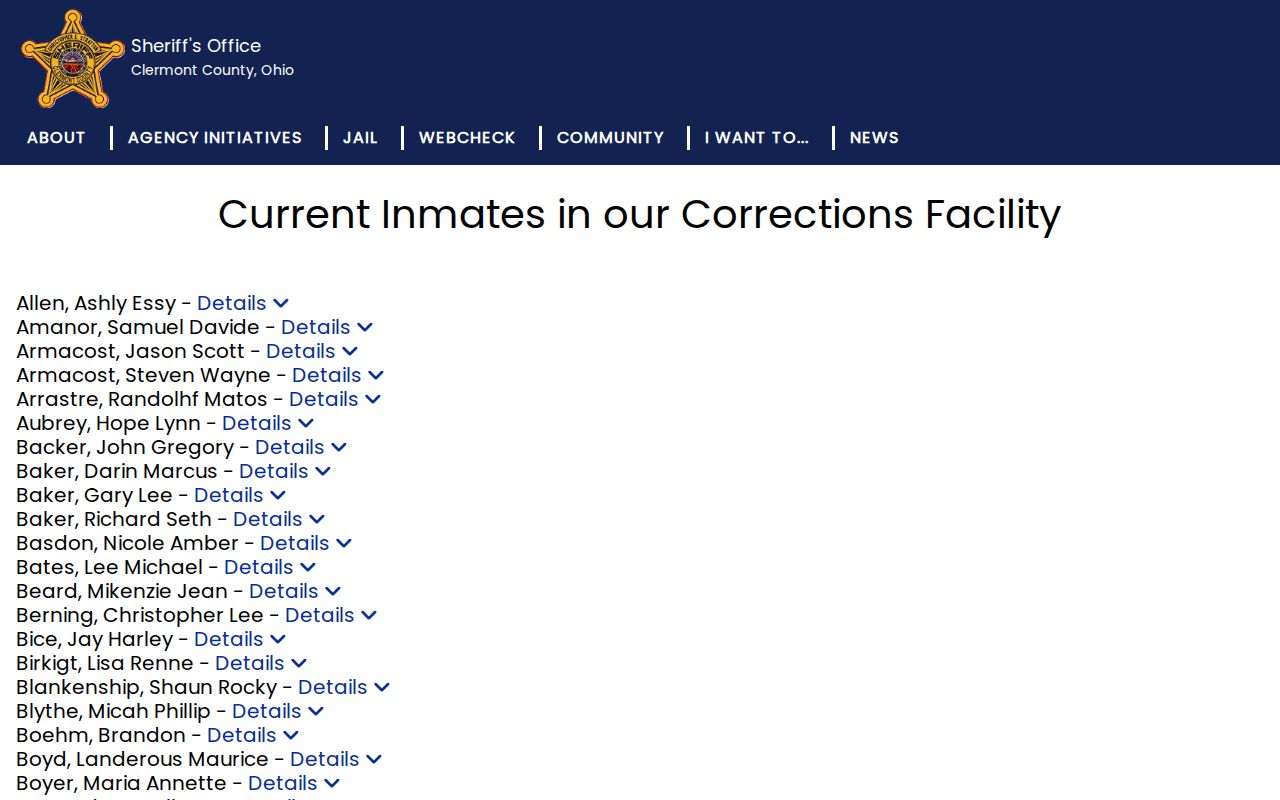
What you see here is a record-search interface, not a gallery of booking photos. Follow the details link for the verified booking and court fields.
| Field | What the Clermont roster displays |
|---|---|
| Identity | Name, date of birth, and sex shown in the detail view. |
| Booking | Booking number and booking date for the county intake record. |
| Charge rows | Charge number or row, code, and description as the jail displays them. |
| Case and court | Case number, court, and court date, which help locate later filings. |
| Bond | Bond type and bond amount, which are not a sentence or final outcome. |
| Photo | No booking photo appeared in the reviewed official interface. |
A few terms do a lot of work here. The booking number identifies the jail record itself. The case number opens the door to court material. A bond is simply the court's release condition. "Disposition" refers to how a case ends, whether by dismissal, plea, trial verdict, or sentence. Keeping these fields straight stops a live roster entry from being read as a finished case.
Clermont Busted Photo Requests
Want a booking photo or an old jail record? The Sheriff's Records Section is the custodian, if it maintains what you seek. The office accepts requests several ways through its public-records request route: NextRequest online, phone, email, or an in-person visit. Staff encourage the online option. It lets you submit, track, and browse an archive of fulfilled requests. The form works well for a focused ask, such as a named booking record and its photograph, whenever that image exists and can legally be released.
For the full list of channels and the Records Section workflow, the Sheriff's public-records page is the source to trust.
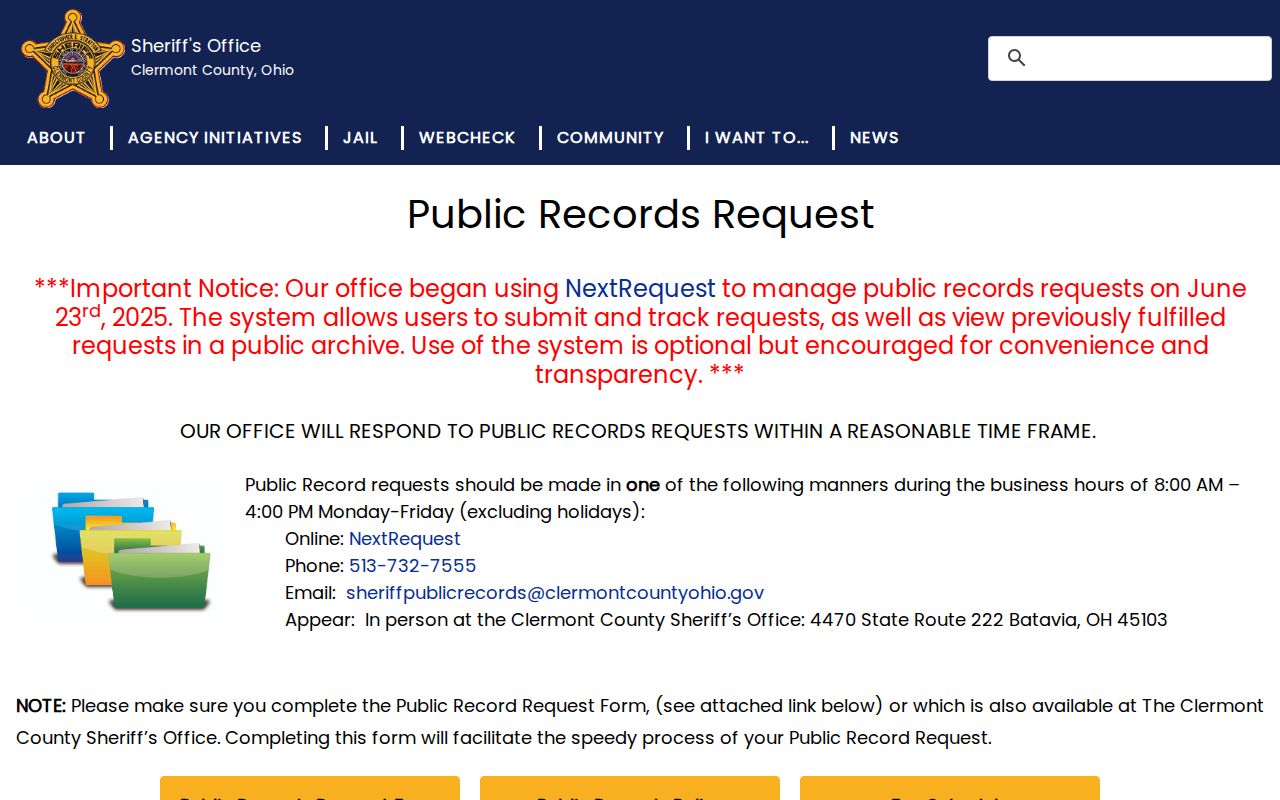
This official request-page view is built for focused booking-record inquiries, and it makes no promise about any specific image.
- Check the official roster first when the person may still be in county custody. Record the name, approximate booking date, booking number, case number, and arresting agency.
- Submit a narrow request through Clermont Sheriff NextRequest, email, phone, or in person. Ask for the booking record and the booking photograph if maintained and releasable.
- State the date range, name, booking or report number, and preferred delivery method. Ask the custodian to identify the legal basis if material is withheld or redacted.
- Use the court number to check the later case. A record request can locate a custody document, but it does not decide whether a charge was sustained.
The posted policy promises prompt inspection or copies within a reasonable window. Timing depends on scope, storage, review, and any redactions needed. It stops short of naming a fixed Clermont booking-photo fee or a firm turnaround time. Copies other than video may carry costs for supplies, storage, mailing, transmission, equipment, or contractors. The policy states plainly that labor is not charged. One caution applies: the video fee rule should not be assumed to cover photographs.
Note: Since the form cannot promise that every image exists or is releasable, ask the custodian directly whether the photograph is maintained.
Ohio Busted Mugshot Rules
Ohio law draws its own lines around booking photographs. The state's Public Records Act covers what an office keeps, how you inspect it, what copies cost, and which exemptions or redactions apply. It stops short of other things. Nothing in it forces a Sheriff to build a brand-new list, promises that a record survived retention, or compels release of a photo the agency never maintained. Juvenile files, sealed or expunged material, victim records, and sensitive law-enforcement information follow separate rules.
A second statute targets the removal racket. Ohio Revised Code § 2927.22 reaches publishers that charge a fee, or solicit any consideration, to take down, fix, or suppress criminal record information, including a booking photo. It is not a blanket erasure order. Government records and independent pages stay where they are. The practical path runs through the originating agency or court first, then a sealing or expungement filing if you qualify, and finally each publisher's own free correction route where one exists.
Sealing and expungement live in ORC § 2953.32. That statute sets eligibility, timing, exceptions, court review, and fees, all of which depend on current law and the facts of the case. Clermont's Common Pleas and juvenile courts publish local forms, which make a workable starting point. One caution is worth stating plainly. A court order reaches official records, yet it does not automatically scrub every independent repost or cached search result. Bring legal questions to a lawyer or a court clerk.
Some secondary publishers offer free removal on their own terms. Busted Newspaper describes a no-fee request that may need the post URL plus supporting legal documents. RecentlyBooked spells out its own free situations, including wrong-person listings, dismissed charges, sealed or expunged records, juvenile material, duplicates, and outdated entries. Other archives write their own policies. None of this comes from Clermont officials, so check anything against the court or agency record before relying on it.
Important. A web listing is not the last word on a case. The court disposition is the source for how it actually ended.
Find Clermont Recent Arrests
Start narrow, then widen only if the facts demand it. The official roster answers the first question: is this person still held at the county corrections facility? An empty result proves little else. Someone can be cited and released, transferred out, booked in another jurisdiction, held by a different agency, or simply processed after you searched. Before concluding anything, match the agency, the holding location, the date, and the court. A clean search window is a starting point, never a verdict on whether an arrest happened.
- Use the Sheriff’s current-inmate search for a person currently visible in the Clermont County Corrections Facility.
- Read the booking, case, bond, court, and charge fields, then preserve the booking number and case number for the next step.
- Check Clermont Municipal case access for municipal criminal matters or the Common Pleas portal for felony-level cases.
- For a city incident, ask Milford, New Richmond, or Batavia Police which agency made the arrest and where the person was lodged.
- When the person no longer appears, make a focused Sheriff records request rather than assuming a third-party result is current.
Here is what the Sheriff does not offer. There is no verified daily booking-photo feed, no 24-hour arrest list, no 72-hour list, and no weekly new-bookings archive. The roster remains the closest official online tool for anyone still in the facility. Keep its edges in mind. Booking details may sit on the page well past the day of the search, while a very recent release may not appear at all.
Clermont Busted Roster Search
The Clermont roster is a current-inmate tool. You get an alphabetical list. Each person gets a details route. The Sheriff's home page says inmate information refreshes at the top of every hour. Treat that as an update statement, not a guarantee. No official source publishes a display lag, a release-posting rule, a maximum online age, or a retention window for the web listing.
For current county custody, start here. The interface showed identity, booking, charge, case, court, and bond fields, though no image. A 2003 renovation expanded the jail's booking and classification space, and the roster is a separate web view bolted onto that operation. Booking someone and publishing them online are two different events.
| Search result | Best next channel | What it means |
|---|---|---|
| Person is on roster | Roster detail, then court docket | Current custody as displayed, not necessarily a same-day arrest or conviction. |
| Person is absent | Arresting agency, court, or Sheriff records | Could reflect release, transfer, another facility, citation, timing, or no matching record. |
| Image is absent | Sheriff Records Section | The reviewed official web roster did not display it; request a maintained, releasable photo. |
Note: A roster row can vanish from the web display soon after release while the underlying county record sits on a different retention schedule.
Clermont Booking Feed Limits
Clermont County has no verified same-day booking feed. There is no 24-to-48-hour feed, no 72-hour page, and no weekly or historical new-bookings archive. The hourly roster answers a narrower question: who is visible in county custody right now. Older booking dates can sit in those results. People who were released, cited, transferred, or never lodged there will be missed entirely.
The Sheriff's press-release archive is agency news, not a full arrest log. One release might cover an investigation, an indictment, a warrant operation, or a single chosen arrest, sometimes long after intake. Names and photos can appear there for public-information reasons. Read it as a sample, not a county-wide list, and treat episodic local news coverage the same way.
Third-party Clermont pages and roster mirrors work as discovery leads once official channels come up dry. Their display windows, update claims, photos, and copied fields set nothing for the Sheriff. Verify every detail with the Sheriff, the court, or the agency that holds the record.
Question: Can a person be booked and never appear in any online Clermont feed? Yes. A citation, a quick release, a different booking destination, a transfer, a processing delay, a redaction, or the simple absence of an official feed all produce that gap. For a specific historical date, a focused records request is the right fallback.
Clermont Busted Alerts and Bonds
Bond details on the Clermont roster answer a narrow question. They show bond type, amount, and court. They won't tell you when someone walks out. The Corrections FAQ sends people straight to the roster for bond and court dates, and victim-rights materials point to VINE and VINELink for custody alerts. Think of VINE as a phone call, text, or email when status changes. It is not a Sheriff mugshot feed and never was meant to be one.
There was no verified Sheriff-branded app with a booking-photo feed, so don't hunt for one. The Sheriff's social accounts do post public information, but posts get edited, delayed, or pulled down without notice. For dependable alerts, register through the Sheriff's VINE information. Notifications arrive by phone, email, SMS, or TTY through linked systems. Coverage of bookings and photos is another matter entirely.
- Bond
- A court-set condition for release, which is different from a sentence or final case outcome.
- Arraignment
- An early court appearance where a charge and rights are addressed under the court process.
- Detainer
- A request or hold involving another authority; it does not itself resolve the underlying case.
Clermont Court Record Paths
Booking screens have limits. Once a case moves to court, the docket carries the story a jail roster can't: arraignment, pleas, motions, dismissals, trial results, and sentencing. Misdemeanors usually run through municipal case access. Felony-level matters go through the Clermont Common Pleas case-access portal. Municipal Criminal Division materials cover complaints, warrants, bail, bonds, and case-file work.
Search smart when you get there. Use the exact name and date of birth, then verify the case number and court before trusting a match. Shared names trip people up constantly. The Common Pleas page warns that online records may lag behind actual filings, and older cases may have limits. The Municipal Clerk routes some older matters to office review. So a blank results screen proves nothing about whether paper records exist.
How a Clermont record unfolds. An arrest or citation comes first. Booking follows if the person is lodged in jail. From there the case moves onto the current-custody roster, then through arraignment and court filings to its final disposition. Expect a different agency, date, and level of access at each step along the way.
State and Federal Custody
County jail is only one layer of custody. The Ohio Department of Rehabilitation and Correction Offender Search tracks state prison and supervision. Profiles show an offender photo, status, institution, county, docket, sentence, and parole or release details. That picture comes from state intake, not county booking, so treat it as a different animal. A county-of-commitment field tells you where the case originated, not where someone lives now or sits tonight.
Federal custody works separately again. The Bureau of Prisons inmate locator covers its own population and offers no public mugshot field, while the ICE Online Detainee Locator handles a different current-custody check. Clermont's 2025 287(g) agreement explains why ICE can appear in local custody paths. Still, a roster entry says nothing about immigration status; confirm that only through the proper federal channel.
Note: A county booking, ODRC profile, BOP result, and ICE locator hit describe four separate custody systems and should never be merged without source-specific confirmation.
Clermont Busted City Records
City police records and county custody records overlap a lot, yet swapping one for the other leads to dead ends. Milford runs through Hamilton County Communications, while New Richmond and Batavia keep their own police routes inside the county. None of the official city pages posts a daily arrest log, 24-hour booking list, or public mugshot gallery. Start instead with the arresting department. Then confirm where the person was actually lodged.
- Milford Busted Mugshots: Milford Police handles city records, while a person held in Clermont County custody may appear on the Sheriff roster.
- New Richmond Busted Mugshots: village police records, county custody, and court timing can all differ after a river-community incident.
- Batavia Busted Mugshots: municipal police, Sheriff, court, and county-seat systems can each hold part of the record.
Each of the three city pages lays out a verified department route. Keep in mind that a release at the scene, an out-of-county hold, a state-prison commitment, federal custody, or an immigration transfer may never generate a Clermont Jail roster row at all.
Older Clermont Booking Records
A record living offline is not a record destroyed. Clermont's Sheriff retention schedule keeps arrest jackets for 72 months, release sheets for 24 months, and the jail register permanently. No separate booking-photo series appears on the schedule. That proves neither existence nor destruction of any photograph. A smart request asks which system or series holds the image, whether it survives, and whether it can be released.
Begin historical requests with the Sheriff, since that office created the county custody record in the first place. If a series was transferred, Clermont Records Management can help with archival logistics, though it isn't the automatic custodian for every jail record. Old court dockets and the Clermont Sun or Courier newspaper archive can pin down dates and reporting history. A newspaper story still can't replace the agency or court record itself.
Question: Does a permanent jail-register entry guarantee a photo? No. A register and a photograph are different record types, with different storage and release rules, so ask the Records Section about the exact booking.